Ball bearings used
on shaft encoder are of main importance, as quality of the encoders relies
also on the coupling precision of its mechanic parts.
Elcis makes use of high precision level ball bearings (ABEC 5-7)
manufactured by the most known firms; severe tests on tolerances and noise
are accomplished before their installation on the encoders.
All Elcis encoders use
two ball bearings, installed as shown in fig. 1, and pre-loaded with high
precision and severe tolerance.
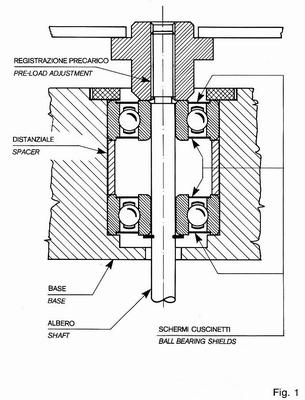
Ball
bearings shields and lubrification depend on expected duty of the encoders
on which ball bearings will be installed:
—
"SEMI-SEALED " BALL BEARINGS, WITH TWO TEFLON SHIELDS AND GREASE
LUBRICANT: used for standard purposes. These ball bearings yield IP 64-65
protection on shaft and 12-20 g • cm starting torque. Maximum continuous
speed can be 6000-8000 r.p.m. with some momentary peaks up to 12 000 r.p.m.
—
"SEALED " BALL BEARINGS, WITH TWO RUBBER SHIELDS AND GREASE
LUBRICANT: used when high protection on shaft is required, as IP 66-67.
Starting torque is about 25-50 g • cm and maximum speed can reach
2500-3000 r.p.m. with momentary peaks of 6000 r.p.m.
—
"LOW TORQUE " BALL BEARINGS, WITH TWO METALLIC SHIELDS AND FLUID
LUBRICANT: used when low shaft starting torque, as 4-6 g- cm, is
requested. These ball bearings are of very high precision (ABEC 7) but
yield a low protection, IP 53. Can be used up to 15000 r.p.m. but require
the use of proper coupling.
—
VERY HIGH PRECISION BALL BEARINGS, WITHOUT SHIELDS AND LUBRICATION: used
only on "encoders for scaling machine ". They show a very low
starting torque (about 2 - 3 g • cm) but they do not give any protection
on the shaft.
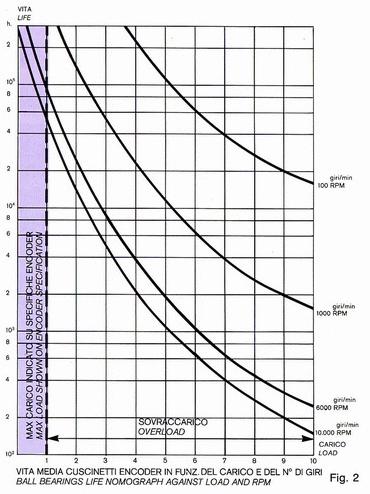
Load
on encoder shaft and consequently on its ball bearings affects mechanic
life of the transducer.
Use of rigid couplings, axially and/or radially, will directly transfer
all backlash and misalignment of the system on the ball bearings and will
drastically reduce encoder's life. From graphic of figure 2 it can be seen
how ball bearings life is affected by load. It Is therefore absolutely
necessary that coupling between encoder shaft and driving shaft is made
through a joint, showing some elasticity in axial and radial sense and
being stiff in torsional sense.
For this purpose it's available a wide range of couplings fitted for its
own transducers.

